
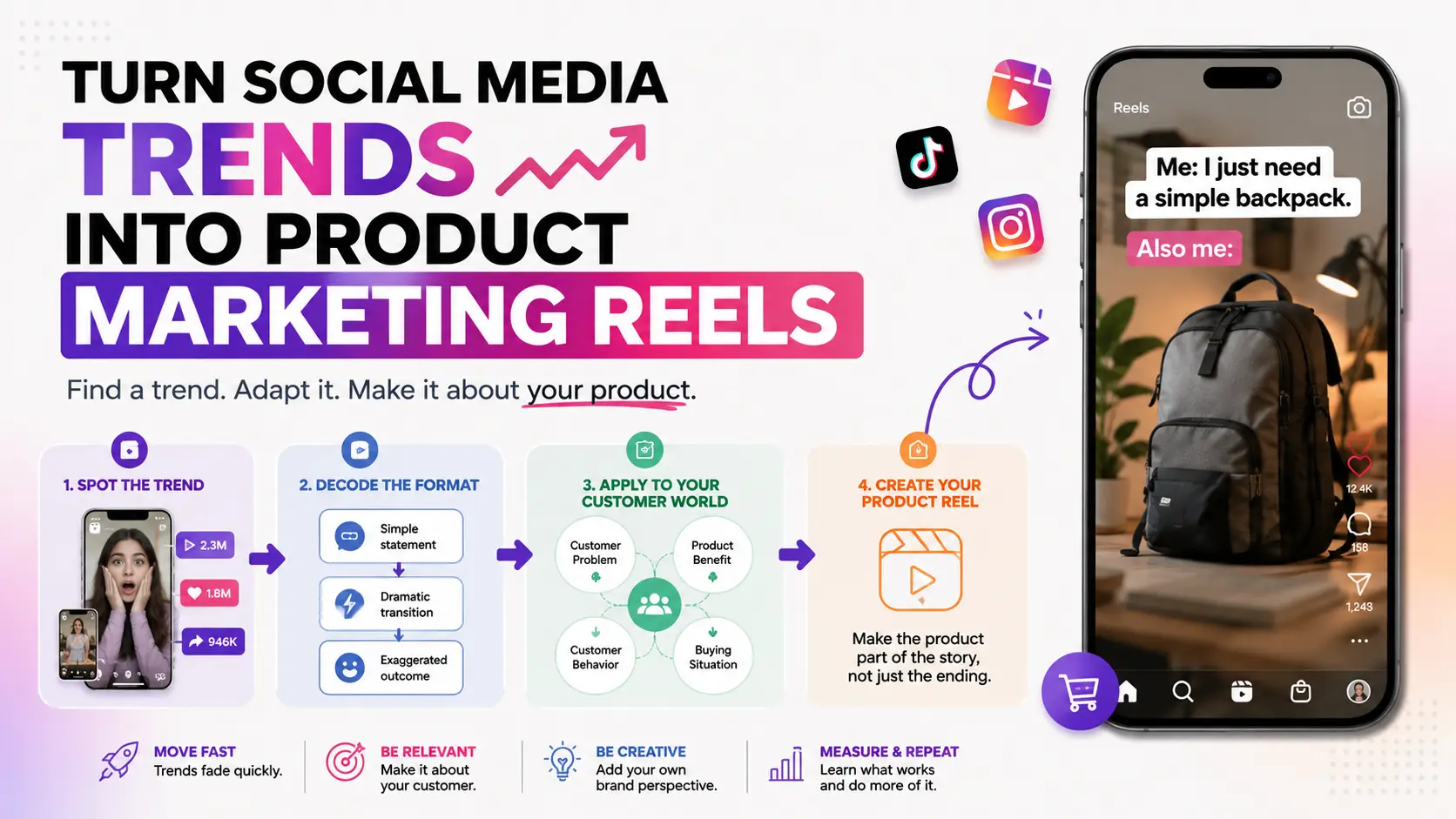
A Reel format starts showing up everywhere.
One creator uses it for a relationship joke. Another adapts it for office life. Someone else uses the same format for travel, shopping, or everyday routines. Within a few days, brands begin joining the trend too.
For product marketers, that creates a useful opportunity.
Instead of building every Reel idea from scratch, you can use ongoing social media trends as creative starting points and adapt them around your product.
The important part is not copying a viral Reel. It is understanding why the format is working, then finding a natural way for your product, customer, or category to become part of it.
Key Takeaways
- Look for repeatable formats, not only trending songs.
- Identify the basic idea behind the trend before adapting it.
- Connect the trend to a customer problem, product benefit, behavior, or buying situation.
- Make the product part of the Reel instead of adding a promotional shot at the end.
- Move quickly while the trend is still gaining attention.
- Try to create several product ideas from every useful trend.
Find Trends That Can Be Adapted
You do not need to participate in every viral moment.
Instead, watch for creative patterns that appear repeatedly across Instagram Reels, YouTube Shorts, TikTok videos, memes, or creator posts.
These patterns may include:
- The same opening phrase
- A recurring joke format
- A POV structure
- A before-and-after reveal
- A specific transition
- A repeated reaction
- A popular audio used in similar ways
- A common text-overlay format
A useful signal is when different creators start applying the same idea to completely different subjects.
That usually means the trend has become a format, not just a single viral post.
For example, imagine several Reels follow this structure:
Someone confidently says they will do something in moderation.
A dramatic transition follows.
The next shot shows that they have taken it much too far.
The subjects may change, but the formula stays the same:
Simple intention, dramatic transition, exaggerated outcome
That is what the marketer should adapt.
Decode the Trend Before You Use It
The biggest mistake is copying exactly what another creator has done and replacing their object with your product.
Instead, ask:
What is actually being repeated here?
A trend may be based on:
- Expectation versus reality
- Problem to transformation
- Statement to unexpected reveal
- POV to relatable situation
- Question to funny answer
- Normal behavior taken to an extreme
Once you identify the structure, you can rebuild it for your audience.
Suppose the format is:
“I said I would only buy one…”
A fashion brand could show an entire wardrobe.
A motorcycle accessories company could show a bike covered in upgrades.
A skincare brand could reveal a complete routine.
A home-improvement brand could show someone who started by replacing one shelf and ended up renovating the room.
The trend stays familiar, but the story becomes relevant to the product category.
Find the Product Bridge
The next question is:
Why should our product be part of this trend?
There should be a clear connection between the trend and something customers already experience.
That connection usually comes from four places.
Customer Problems
What frustration does your product solve?
A productivity tool can join a trend about chaotic workdays. A storage product can fit naturally into content about clutter. A luggage brand can use a format built around overpacking.
The product works because the situation already belongs to the customer’s world.
Product Benefits
Some formats naturally demonstrate an outcome.
Think:
- Slow to fast
- Messy to organized
- Before to after
- Difficult to easy
- Ordinary to improved
When the benefit can be shown visually, the product does not need a long explanation.
Customer Behavior
Relatable behavior is often stronger than a product feature.
Examples:
“Motorcycle owners saying this is definitely their last accessory.”
“People buying another black T-shirt because this one is slightly different.”
“Someone buying running shoes and immediately planning a marathon.”
The customer recognizes themselves, while the product stays central to the joke.
Buying Situations
Think about what happens before and after the purchase.
Researching products, waiting for delivery, unboxing, trying something for the first time, upgrading, or explaining the purchase to someone else can all become trend-based Reel ideas.
Put the Product Inside the Reel
A common branded Reel structure looks like this:
Trend, joke, product shot, buy now
The problem is that the product feels like an advertisement added after the entertaining part.
A better approach is to make the product part of what makes the Reel work.
For example, a suitcase company could use:
Text: “Me: I’m packing light for this trip.”
Cut to someone sitting on an overflowing suitcase trying to close it.
The suitcase is not interrupting the joke. It is the joke.
A coffee machine brand could use:
“Me: Buying a coffee machine will save money.”
The next shot reveals a grinder, specialty beans, scales, cups, and an increasingly elaborate home coffee setup.
The product gets visibility without stopping the Reel to explain itself.
Translate the Trend Into Your Customer’s World
A simple way to generate better ideas is to ask:
What would this trend look like if it happened to our customer?
Suppose the format is:
“Nobody warned me that…”
A travel brand might create:
“Nobody warned me that a two-day trip requires six outfits.”
A software company could use:
“Nobody warned me that the temporary spreadsheet would still be running the business three years later.”
A running brand might post:
“Nobody warned me that buying running shoes would become a personality.”
The creative format remains recognizable, but the context changes.
That is the difference between copying a trend and adapting a trend.
Do Not Limit Trend Watching to Audio
Trending audio can help a Reel feel familiar, but the audio is not always the most valuable part.
Many trends are based on structures that can work with several sounds or even no music.
Examples include:
POV: “POV: You said this would be your last bike modification.”
Expectation versus reality: “How I thought traveling light would look versus what actually happened.”
Different types of people: “Three types of people packing for a weekend trip.”
Things that make sense: “Features in this backpack that just make sense.”
Thinking this way makes the idea easier to adapt across Instagram, TikTok, YouTube Shorts, and paid social creative.
Move While the Trend Is Still Relevant
Trend-based marketing has a much shorter opportunity window than regular campaign content.
A trend spotted today may feel overused after a few weeks. That means brands need a faster workflow.
A practical process looks like this:
Spot the trend, decode the format, find the product connection, create the concept, shoot, edit, publish
The biggest delays often come from approvals.
Brands that plan to use trends regularly can define basic rules in advance around:
- Acceptable humor
- Permitted product claims
- Brand visual guidelines
- Topics to avoid
- Approval ownership
- Situations that require legal review
The objective is not to remove control. It is to avoid restarting the entire approval process for every simple social post.
Get More Than One Reel From a Trend
When you find a strong format, do not stop after one idea.
Ask:
How many customer situations could fit this?
Suppose the trend is:
“Things that just make sense.”
A luggage company could create:
“Things in this cabin bag that just make sense.”
“Things frequent travelers do that just make sense.”
“Things you understand after switching to lightweight luggage.”
One trend can become a small content series instead of a single post.
This also makes trend discovery more valuable for brands with large product catalogs.
A Simple Trend-to-Reel Process
Use this six-step framework whenever you spot something interesting.
1. Spot
What idea or format is repeating?
2. Decode
What is the basic creative formula?
3. Connect
Which customer problem, behavior, product benefit, or buying situation fits it?
4. Adapt
How would the trend look in your customer’s world?
5. Create
Can the product become part of the story instead of an advertisement at the end?
6. Multiply
Can you create two or three additional versions from the same trend?
This gives product marketers a more systematic way to create short-form content without forcing the product into formats where it does not belong.
Do Not Chase Every Trend
The goal is not to turn the brand into a constant follower of internet trends.
Most trends will not be relevant. Some will not fit the product, the audience, or the brand voice.
The real skill is recognizing the moments where audience interest and product relevance overlap.
Social platforms continuously show marketers which creative structures people are reacting to, sharing, and recreating. That makes trending content a useful source of inspiration.
Instead of asking:
“What Reel should we make this week?”
Start asking:
“What formats are already gaining attention, and what would one of them look like in our customer’s world?”
When the answer naturally involves your product, you have the foundation for a strong product-marketing Reel.