

Key Takeaways
- The strongest aggregated evidence for Reels Trending Ads currently sits at the top of the funnel, particularly around unaided awareness and ad recall.
- Early studies also show movement in consideration and action intent, but these findings come from smaller beta-study groups and should not be treated as universal benchmarks.
- Trending placement can create a valuable context for attention, but Reels-native creative still matters. Vertical video, audio, safe-zone compliance and strong visual storytelling remain important to performance.
Reels Trending Ads have a straightforward premise: place advertising immediately after Reels that are already attracting attention and shaping conversations. The more useful question is what happens after that exposure. Does appearing next to trending content simply increase visibility, or can it measurably change brand awareness, recall, consideration and intent?
Early evidence points most strongly to brand-building outcomes near the top of the funnel. There are also signs of impact further down, although the evidence becomes narrower there. For marketers, the results are more useful as signals about where and how to test the format than as guaranteed performance benchmarks.
First, What Does Brand Lift Actually Measure?
Brand lift measures the difference in brand perception or behaviour between people exposed to an advertising campaign and a comparable group that was not exposed. Rather than asking only how many impressions or video views an ad generated, a lift study looks for evidence that advertising changed a measurable brand outcome.
Several terms appear frequently in Reels Trending Ads measurement:
- Ad recall lift measures the increase in people who remember seeing an advertisement after being exposed to the campaign. An incremental ad-recall lift of 6.6 points, for example, represents the difference between exposed and control groups, rather than saying that overall ad recall was 6.6%.
- Unaided brand awareness measures whether people can name or recall a brand without being shown its name first. Lift in this metric indicates that the campaign made the brand more mentally available to consumers.
- Consideration lift measures the increase in people who say they would consider a brand, product or service after campaign exposure.
- Action-intent lift looks further down the funnel at whether exposure increases a person's stated likelihood of taking a relevant action.
- Message-association lift measures whether more people connect the brand with the message or idea the campaign was intended to communicate.
A percentage-point lift should also not be confused with a percentage increase. If a metric moves from 20% in a control group to 26% among exposed consumers, that is a 6-point lift, even though the relative increase is 30%.
These distinctions matter when interpreting campaign results. A lift figure measures the incremental difference associated with advertising exposure, not simply the total number of people who remembered or considered the brand.
Reels Trending Ads Are Primarily Showing Strength in Brand Metrics
Awareness and recall currently provide the clearest evidence.
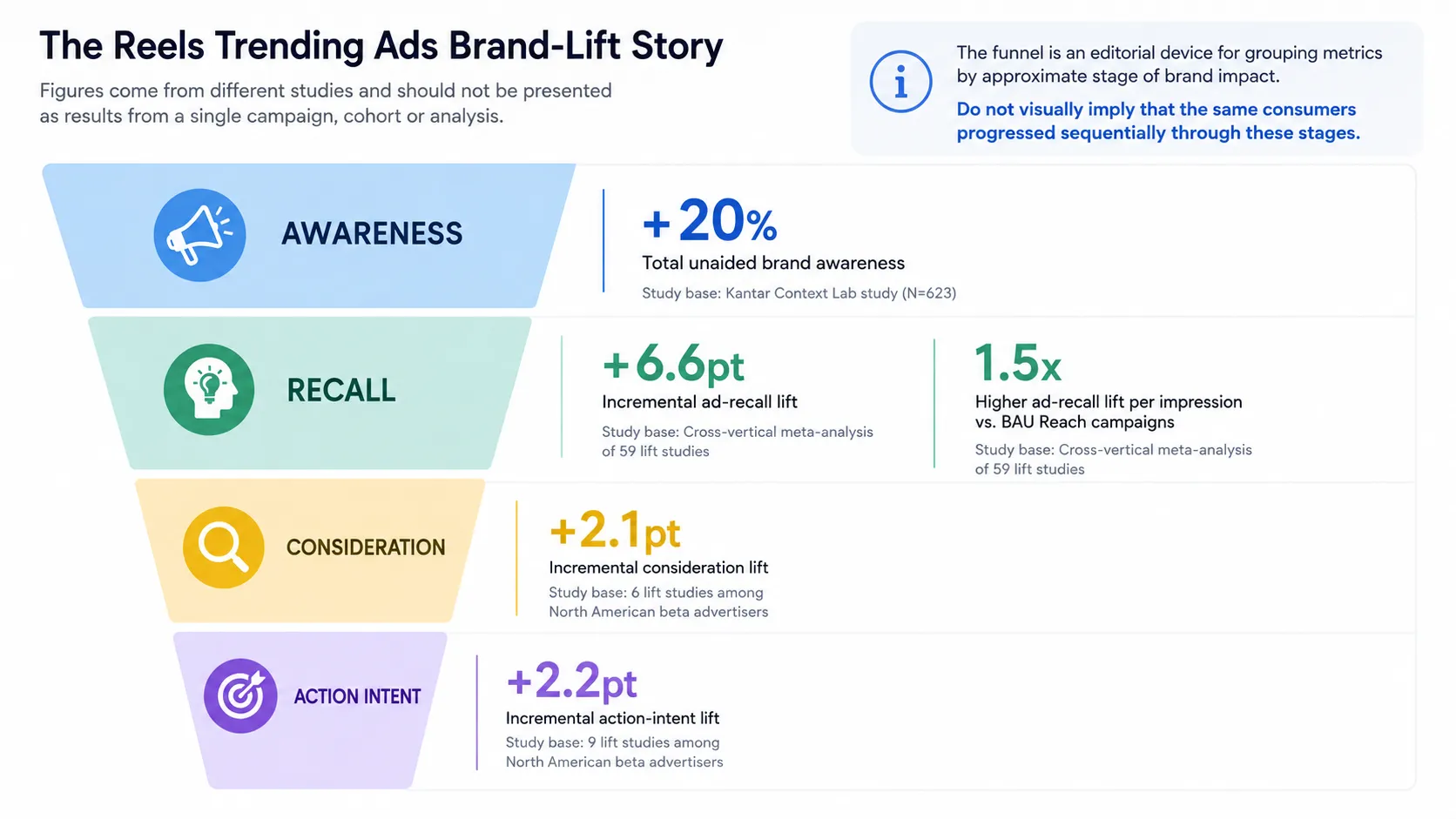
A cross-vertical statistical meta-analysis of 59 lift studies found a 6.6-point incremental ad-recall lift. It also recorded 1.5x higher ad-recall lift per impression compared with business-as-usual Reach campaigns. Separate research found a 20% increase in total unaided brand awareness.
The measures tell different parts of the story. Unaided awareness indicates whether a brand comes to mind without prompting. Ad recall is more closely tied to whether people remember the advertising itself.
The 1.5x ad-recall lift per impression result adds another dimension. Lift per impression considers the brand effect relative to the amount of exposure delivered. In practical terms, it helps marketers examine whether each impression is producing more brand impact rather than simply whether a campaign generated more lift by delivering more impressions.
That makes trending adjacency particularly interesting for awareness campaigns. The potential value may not simply come from reaching somebody on Reels, but from reaching them immediately after content already commanding their attention.
The Effect May Extend Beyond Awareness
The evidence becomes more limited further down the funnel, but it does not disappear.
A cross-vertical analysis involving nine North American beta lift studies found a 2.2-point incremental action-intent lift. Another analysis covering six beta lift studies found a 2.1-point incremental consideration lift.
These metrics represent a different stage of influence. Awareness asks whether the brand entered someone's mind. Consideration asks whether it entered the set of options they might choose. Action intent goes a step further by looking at whether people report being more likely to take a relevant action.
The study base is important. These findings came from North American advertisers participating in beta testing rather than a large global pool of established campaigns. They are therefore better viewed as early evidence of potential mid-funnel impact than expected results for every advertiser.
Even with that limitation, the direction is useful. If trending adjacency affected only visibility, marketers would expect the clearest movement to stop at awareness and recall. Consideration and action-intent lifts suggest that, under some campaign conditions, the effect can continue into how people evaluate a brand and what they intend to do next.
Campaign Results Show Different Types of Impact
Individual campaign studies provide another view because the measured effect does not always appear at the same point in the funnel.
A travel-sector campaign recorded a 16.4-point lift in unaided awareness, an 11.8-point lift in message association and a 19.3-point lift in consideration. The result shows movement from remembering the brand toward connecting it with the intended message and considering its offering.
A food and beverage campaign produced a 13.1-point ad-recall lift, 4.1-point unaided-awareness lift and 5.7-point consideration lift. It also generated 22% higher three-second video plays compared with the advertiser's usual campaign. Video plays are an engagement metric rather than a Brand Lift metric, but looking at the two together can help marketers understand both viewing behaviour and changes in brand perception.
An entertainment-sector campaign recorded a 26-point ad-recall lift, 17.7-point awareness lift, 9.7-point action-intent lift and a 22% lift in ticket purchases. Here, measured impact appeared across brand recall, intent and an eventual commercial outcome.
Other retail and consumer campaigns have also recorded improvements in measures such as ad recall and favorability.
These cases should not be averaged together or converted into planning benchmarks. Sector, audience, creative, media mix, timing and campaign design differ substantially. Their value is in showing the range of outcomes that can be measured, not predicting what another campaign will achieve.
Infographic 2 — How Brand Impact Appeared Across Sectors
Create three vertical cards without advertiser names:
Travel Unaided awareness → Message association → Consideration
Food & Beverage Ad recall → Unaided awareness → Consideration → Video engagement
Entertainment Ad recall → Awareness → Action intent → Purchase
Include the corresponding figures and clearly label them as individual campaign results, not benchmarks.
Cultural Placement Does Not Remove the Need for Strong Creative
Trending adjacency can put an advertisement in a potentially valuable viewing context. It cannot make weak creative compelling.
Broader Reels creative research found that campaigns using 9:16 video with audio, safe-zone compliance and at least one additional Reels-style creative element were associated with a median 20% lower cost per click, 56% higher click-through rate, 93% higher ThruPlay rate and 30% higher three-second video-play rate compared with campaigns relying only on business-as-usual creative.
These are general Reels creative findings, not Reels Trending Ads performance results. They help explain which creative characteristics tend to work well in the Reels environment; they do not show that trending placement caused those performance differences.
For context, CTR (click-through rate) measures the share of impressions that result in a click, while CPC (cost per click) measures how much an advertiser pays, on average, for each click. ThruPlay is a video-view metric used to capture more substantial video consumption than an initial three-second view.
A separate large-scale creative analysis covered 56,984 creatives across 1,295 campaigns and 13.1 billion impressions. Higher effectiveness was associated with factors including making the brand integral to the creative, visually dynamic execution, distinctive brand colours and featuring people.
The practical implication is that placement and creative perform different jobs. Trending adjacency determines where the brand enters the viewing experience. Reels-native execution influences whether the viewer continues paying attention once it gets there.
Infographic 3 — Placement Gets Attention; Creative Still Has to Work
Create a left-to-right flow:
Trending placement Culturally relevant adjacency Brand suitability Trending or topical selection
→
Reels-native creative 9:16 video Audio Safe-zone compliance Early hook People Text overlays Dynamic editing
→
Potential outcomes Attention Recall Consideration Action
If general Reels performance figures are included, add a prominent qualifier: “General Reels creative research — not specific to Reels Trending Ads.”
What Marketers Should Take From the Evidence
The current evidence supports a few useful conclusions without turning early results into promises.
Awareness and recall have the strongest evidence. The larger aggregated study base sits around top-of-funnel measures, making these the most defensible outcomes to prioritise when evaluating Reels Trending Ads.
Mid-funnel impact is possible, but the evidence is earlier. Consideration and action-intent results make a useful testing hypothesis rather than a universal expectation.
Different sectors can produce different lift patterns. Travel, food and beverage, entertainment, retail and other campaigns have recorded movement at different points in the funnel. There is no single Brand Lift profile that applies to every advertiser.
Creative quality remains part of the equation. Cultural relevance can create the context for attention, but the ad still needs to communicate quickly and naturally within Reels.
Most importantly, individual campaign lifts are examples, not guarantees. Audience, creative, campaign duration, surrounding media and measurement design can all change the result.
What to Test Next
The useful question for an advertiser is not whether it can reproduce another campaign's headline lift. It is whether Reels Trending Ads produce incremental value compared with the media activity the brand would otherwise have run.
That is the purpose of incrementality measurement. Instead of counting every outcome that happens after someone sees an ad, it attempts to identify the outcomes that happened because of the advertising exposure.
Brand Lift testing can apply that principle by comparing exposed and control audiences and measuring changes in metrics such as ad recall, favorability and consideration.
The existing evidence therefore provides a starting hypothesis rather than a promised result: Reels Trending Ads appear particularly promising for awareness and recall, with early indications of influence deeper in the funnel. A controlled lift study can show whether that pattern holds for a specific sector, audience, creative approach and campaign.